Brief musings on taking my kid to boarding school (or on watching her take a journey; or on taking my own journey).

img_2129

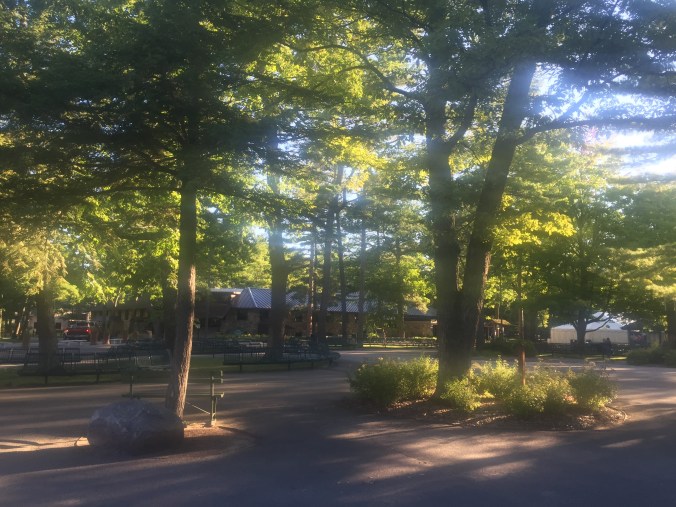
Interlochen Campus

It was a rush decision, a true leap of faith, to send Fiona away to Interlochen Arts Academy http://academy.interlochen.org/, a premier boarding high school for young artists, in Interlochen, Michigan.  It is her senior year and we were not expecting to “let her go” so soon.  It was truly the best thing for her (that will appear in a separate post in maybe 6 years).

I had two weeks to prepare for her departure.  The physical and mental tasks involved were mundane but fun; like preparing to go away to college, the first time in the dorms.  I think I’m pretty attuned to my emotions but even so, I was not prepared for the iron weight of saying “goodbye.”

img_2058Some lessons I learned ( because there were many I probably have not uncovered yet) the weekend Lizzy (younger sister) and I dropped Fiona off at Interlochen (Opening weekend):

  1. No matter how hard parenting a teenager is, and how painful it can be, my love for my teens (kids – whatever age), will ALWAYS overshadow that pain and difficulty.  Saying goodbye is intense and heavy and wonderful when it’s right.
  2. The more siblings argue, the stronger the bond.  (I don’t actually have any proof of this but I’d like to think that the sibling bond I’ve witnessed, in my own kids and in my own relationships, is stronger than any).
  3. You can go further, and better, with your community (Thank you my friends and family!).  And your continued journey (or Pilgrimage) will always be better when you include your people and open yourself up to your community.
  4. “Pilgrimage” is a good word.  It takes on many meanings: like a quest, or a personal journey; or a literal journey; or a discovery of new lands.
  5. Eating balanced meals every day is good.  Actually, it can change your life.  Not eating balanced meals can make you very sad.
  6. I apologize in advance for this next lesson but it has to be said:  Michigan drivers are obnoxious, but also serious about adhering to highway etiquette (i.e. left lane for passing only); Indiana drivers may very well be very lovely people, but they don’t know bunk about the “rules of the road;” Wisconsin drivers are both of these bad things.  Illinois.  I can’t.
  7. Mostly, I learned that seeing your child in the right place is wonderful and warms your heart.  It isn’t because of me or her father that she’s there.  It is not an outside force.  It’s her own self that got her where she is and what will make her experiences (of course with the community and family holding her up should she stumble).  Being a proud parent is the best.

Thank you Interlochen for showing me my own personal pilgrimage.  
img_2144

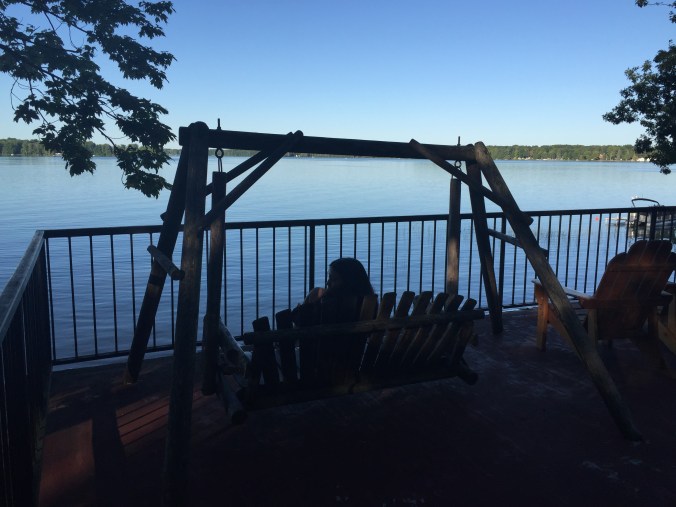
Lizzy at Interlochen campus

For a glimpse into Interlochen and that special opening weekend, here is an archived webcast of the Opening Convocation. One of my favorites was the talk given by Nicola Conraths Lange, Director of Comparative Arts, on “What to bring and what to leave behind” (towards the middle of program).

http://www.interlochen.org/media/archived-webcast-interlochen-arts-academy-2016-2017-opening-convocation-9-3-16

School is a shark

I felt slightly melancholy dropping my kids off at school this morning.  My 3rd grader, Robert, dragging his feet, walked slowly, adjusting his backpack as he approached the regular crowd of kids chattering away as they squeezed into the front doors.  It was a bright, soft spring morning, with birds chirping and Robert was being consumed by kids rushing over concrete towards the tall brick structure they call school.  I almost lost sight of him as I pulled the car away for other parents to let their kids out. On the radio was V.V. Brown’s “Shark in the Water,” which I’m sure in reality does not relate to this situation at all.

But, it seemed Robert was surrounded by sharks at school:  curriculum constraints, teachers and their old ways (name on the board if you drop a pencil; copy the dictionary if you talk in class); endless worksheets, boring days filled up by lessons consisting of students reading from a textbook; not real interactive classroom time or fun projects.  For some reason, these mindless worksheets-and I think most parents of kids this age know what I’m talking about-weigh more heavily on Robert than his sister.  But actually, now that I think about it, Mae never had those mindless worksheets.  She and Robert both attended a Montessori school until she was entering fourth grade.  In Montessori, they generally did not have the worksheets.   By the time she was in the “regular” school, she surpassed her peers in language arts and math and somehow managed to get a pass on all the worksheets too.  Robert was not so lucky.  Although he too surpassed his peers in both reading and math, he was expected to do the worksheets and endless busy work that is often so difficult for boys.

Why is that? Why is it that at every school Robert has attended (there have been 3 in his short life); we have felt that he has not been understood or been treated unfairly?  Well, the simple answer of course is that he hasn’t been understood and he has been treated unfairly.  Why was he prohibited from reading books that were challenging for him when the same teacher had allowed his older sister to read challenging books (or books she wasn’t even capable of really reading at the time) only two years earlier? She held preconceptions about boys and girls, that’s why. Education these days is intolerant of boys and the drop out rate for boys is only increasing as a result.  From an early age, boys are told to sit still.  School is designed for children to sit at attention for long periods of time, which for many girls, is perfectly fine.  But it hurts boys.  They need to work their large motor muscles at a young age, when girls are moving on to fine motor skills.

I’ve read a lot about the education and development of boys, including “Raising Cain: Protecting the Emotional Life of Boys” by Michael Thompson and Peg Tyre’s “The Trouble with Boys.”  Both books have enlightened me and somewhat depressed me too.   While we have an educational system that allows girls to thrive and leaves boys way behind, it’s what we have.  We as parents have to constantly advocate, for all of our children, but especially our boys.  My biggest fear is that Robert’s self confidence, innocence, and love of learning will be sucked out of him by preconceptions, assumptions and direct degradation by the school system.  He tells me now that he likes doing dictionary because he learns new words, but I know he’d rather be running around.  Robert doesn’t speak up for himself when he gets blamed unfairly, and he doesn’t explain his digressions to teachers.  Maybe it’s because when he has done so in the past, it has made little difference.  Or maybe it’s because “school” has taught him that the explanation really doesn’t matter.  The context and nuance of a situation cannot be understood in a public system where a teacher has too many worksheets to correct and test scores to worry about, along with his or her job, thanks to No Child Left Behind legislation.

It’s not all doom and gloom with school though. His school is pretty cool, they go on a lot of field trips to downtown museums, plays, and musical performances.  The kids also have quite a bit of extracurricular options, including guitar and chess club.  Unfortunately, these great things about the school might be overshadowed by the drudgery of the day as I’ve explained it, as Robert has explained it.

The best solution, as I’ve said we have come up with so far is to always be your child’s advocate.  Always listen to your child, especially when he’s not talking.  This means enduring the worksheets with him, as maddening as it is, and educating him yourself, in a way he responds to, including lots of playing.  I’m not exactly enthusiastic about museums but the joy our son gets out of those visits is immeasurable.  That is enough for me.   It isn’t easy, especially when money and time are scarce, but a walk in the park, a bike ride, working on a puzzle or playing a board game will erase all the worries about school work and grades.  And the look on his face when he’s playing and learning compared to the look on his face this morning makes it easier.  So while I was sad today, watching Robert, I feel better for him, knowing we are on his team.  I must never forget, he must never forget, we are on his team.

Ramona’s Lessons in Parenthood

When I was a young child, I read a lot.  I loved to escape to the dumbwaiter with “Harriet the Spy,”  a book I re-read over and over.  And I understood Ramona, because I think I, too was a pest.   I spent summer afternoons and countless evenings reading, with my mother or by myself.  I remember being in school, anxious to leave to get back to whatever book captivated me at that time.  Saturday afternoons spent at the Public Library are precious memories.  I affectionately remember the smell of the library, old books, and the crinkly plastic covers on the books to protect them.

When in high school, however, I took little pleasure in reading.  It seemed so much of my reading was forced on me.  I might now enjoy great British or American authors but in school, it was stilted and boring.  I remember dreading American Authors class and “The Red Badge of Courage,”  by Stephen Crane, described as one of the most influential books in American literature; a book my 8 year old son might grow to love.  But at the time, that and “The Scarlett Letter” by Nathaniel Hawthorne, were simply dreadful.  Which, by the way is interesting because I think “The Scarlett Letter” is one of the most intriguing books about Puritanism and the psychology of sin. Somehow, I don’t think it was quite presented to me that way in high school.  I think my dislike of literature grew because of the way I was expected to learn about these works.  It was not for the enjoyment at all. Continue reading

The police at school

Yesterday, I picked up my children after school.  They attend a public school, an urban school with a gifted & talented program.  I love their school.  And it is a very urban school, and I mean that in the best sense.  It resides near downtown, which allows for them to take walking field trips, to plays, concerts and museums.  As with any other public school, there are all types of students.  Some might have issues at home-poverty, violence or absentee parents. Some students are more privileged and their parents choose to keep them in the public schools. Honestly, if our kids did not get accepted to this school, they might not attend the public schools.  We’ve seen a few first hand and it’s tough.

There’s a girl Mae has mentioned, I’ll call her “Jane.”  Jane  was in Mae’s class last year. Mae has talked about how she likes her, she’s a great writer and funny.  At the same time, Jane has been in some fights at school-behavior that Mae had not been exposed to before attending her school.  But despite this, Mae was never afraid of Jane. This year, Jane has had a hard time, by Mae’s accounts (my assessment though).  Mae has always shown consideration when talking about Jane and always, always mentions how nice she is.  It was recently that Mae informed me that Jane was no longer at their school, after some incident.  I’m not sure what the set-up is, but Jane rides the bus with the students from their school still.  I think, until yesterday. Continue reading